Pages

Tuesday, 18 October 2016

BMW's Futuristic Motorcycle Balances on Its Own


The motorcycle of the future is so smart that it could eliminate the need for protective gear, according to automaker BMW.
To mark its 100th birthday, BMW has unveiled a number of concept vehicles that imagine the future of transportation. Possibly its most daring revelation, the so-called Motorrad Vision Next 100 concept motorcycle is so advanced that BMW claims riders wouldn't need a helmet.
The Motorrad Vision Next 100 would have a self-balancing system that keeps the bike upright both in motion and when still. BMW touted the motorbike's futuristic features, saying it would allow for riders of all skill levels to "enjoy the sensation of absolute freedom." According to the automaker, the Motorrad wouldn't require protective gear such as helmets and padded suits. [Photos: The Robotic Evolution of Self-Driving Cars]
Another traditional feature was also missing from the concept: a control panel. Instead, helmetless riders would wear a visor that acts as a smart display.
"Information is exchanged between rider and bike largely via the smart visor," BMW said in a statement. "This spans the rider's entire field of view and provides not only wind protection but also relevant information, which it projects straight into the line of sight as and when it is needed."
Such information would not be needed all the time because drivers will be able to hand over active control of the vehicle at points; the Motorrad and other Vision Next 100 vehicles would be equipped with self-driving technology, according to BMW.


The futuristic motorcycle and other concepts released during the centennial event were noted as "zero emissions" vehicles, because BMW said it believes the future of transportation is electric. 
Other concepts in the Next 100 Years series included a massive Rolls-Royce (measuring nearly 20 feet long) that is referred to as "her" because of the vehicles' AI called Eleanor. Eleanor is fully autonomous, with a couch instead of seats and no steering wheel. BMW also unveiled a Mini concept that is partially transparent and designed completely around car-sharing. No need to own this future Mini, because BMW said the vehicle can be called to a location with an app, arriving autonomously, and ready for use.
Original article on Live Science.

Bendable Battery May Power Future Wearable Devices, Smartphones

new bendable lithium-ion battery that can flex and twist could power wearable devices and one day be used to develop a flexible smartphone, according to Panasonic, which is developing the new battery.


Although it's still in the early stages of development, the battery already has been tested to withstand twists, bends and other deformations while maintaining its ability to hold a charge, according to Panasonic. In contrast, a regular lithium-ion battery, commonly used in smartphones and other gadgets, can degrade when it is deformed, thus shortening the device's operating time, the company said.
The battery was unveiled earlier this month during the annual Combined Exhibition of Advanced Technologies (CEATEC), a technology fair held from Oct. 4 to Oct. 7 in Japan. [10 Technologies That Will Transform Your Life]
Lithium-ion batteries can be highly volatile if they malfunction, as was the case with the Samsung Galaxy Note 7, which was plagued by battery problems that caused them to overheat and sometimes explode. Faulty batteries can catch fire when they are overcharged, because the lithium ions can collect in one spot and be deposited as metallic lithium. If this happens, the heat from the overcharging can cause oxygen bubbles to form, which are highly reactive with metallic lithium. If they combine, this can lead to an explosion.
Panasonic's bendable battery uses "a newly developed laminated outer body and internal structure" that the company said makes it difficult for the battery to leak or overheat. With this new casing and internal wiring, the battery is both safer and more reliable for wearable tech devices, the company said.
The bendable battery is just 0.02 inches (0.55 millimeters) thick, and was able to withstand being bent so that the curve of the battery has a radius of 25mm, and being twisted up to 25 degrees in tests, according to Panasonic. The company noted that the capacity of these batteries is still small — they can hold a charge between 17.5 mAh (for the smallest size) and 60 mAh (for the largest). For comparison, the iPhone 7 has a 1,960-mAh battery. Though further development is needed before the battery will be ready for use in smartphones, the invention could be suitable for low-power devices such as smart cards or smart clothing, Panasonic said.
"When used in card devices such as smart cards and card keys that work on batteries, as well as body-worn devices and smart clothing, this battery can retain its characteristics even if the device is frequently bent or twisted," the company said in a statement.
Though samples of the battery were on display at the conference and sample shipments are scheduled for the end of the month, Panasonic said mass production will require further product development.
Original article on Live Science.

Friday, 20 February 2015

2015 Hyundai Verna New Model Launch in India


Price List

Petrol –
  • Base 1.4 Petrol – INR 7.73L
  • S 1.6 Petrol – INR 8.84 L
  • S (O) 1.6-litre Petrol – INR 9.38 L
  • SX 1.6-litre Petrol – INR 10.15 L
  • S (O) 1.6-litre Petrol Automatic – INR 10.11 L
Diesel –
  • Base 1.4 Diesel -INR 8.95 L
  • S 1.6-litre Diesel – INR 9.99 L
  • S (O) 1.6-litre Diesel – INR 10.59 L
  • SX 1.6-litre Diesel – INR 11.46 L
  • SX 1.6-litre Diesel Automatic – INR 12.19 

Design 

Hyundai designed the new 2015 Hyundai Verna  Solaris at the 2014 Moscow International Automobile Salon Motor Show. Called the Solaris in Russia and the Accent in some other parts of the world, the Hyundai Verna sedan has undergone an appreciable Solaris  at the front fascia


Thursday, 27 November 2014

Celkon released India's cheapest windows phone

Now Celkon also  joined  domestic handset makers such as Karbonn, Micromax, and Xolo with the launch of its first Windows Phone-based smartphone in India, the Win 400.

The Celkon Win 400 is now available to purchase from an online  shopping  website priced at Rs. 4,999. But  Celkon yet to announce about the official launch of the smartphone, nor is it listed on the company site.

Features :

The Celkon Win 400 features a 4-inch HD (480x800 pixels) IPS display, and is powered by a 1.3GHz quad-core Qualcomm Snapdragon 200 (MSM8212) alongside 512MB of RAM. It sports a 5-megapixel rear camera with LED flash, while it also houses a 1.3-megapixel front-facing camera. The smartphone includes 4GB of inbuilt storage which is further expandable via microSD card (up to 32GB).
The smartphone is currently listed in Black colour only at Snap deal. The smartphone measures 125.4 x 65 x 10.3 mm and weighs 121 grams. A 1500mAh battery which is rated to deliver up to 5 hours of talk time and up to 200 hours of standby time. The Celkon Win 400 comes with GPRS / EDGE, 3G, Wi-Fi, Bluetooth, GPS and Micro-USB connectivity options.
In online shopping  site's price tag for the smartphone, the Celkon Win 400 is cheapest smartphone with Windows Phone 8.1 - leaving behind Karbonn's Titanium Wind W4  in India which is retailing in the Indian market at Rs. 5,999.


Monday, 24 November 2014

Smart Cars Vulnerable to Hacker Attacks

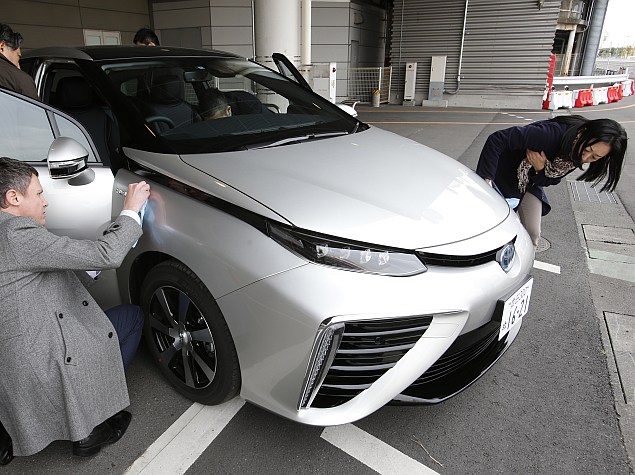
japan_fuel_cell_car_toyota_ap.jpg


Meticulously overwhelming its computer networks, the hackers showed that - given time - they would be able to pop the trunk and start the windshield wipers, cut the brakes or lock them up, and even kill the engine.
Their motives were not malicious. These hackers worked on behalf of the U.S. military, which along with the auto industry is scrambling to fortify the cyber defenses of commercially available cars before criminals and even terrorists penetrate them.
"You're stepping into a rolling computer now," said Chris Valasek, who helped catapult car hacking into the public eye when he and a partner revealed last year they had been able to control a 2010 Toyota Prius and 2010 Ford Escape by plugging into a port used by mechanics.
These days, when Valasek isn't working his day job for a computer security firm, he's seeing how Bluetooth might offer an entry point.
Automakers are betting heavily that consumers will want not just the    maps    and music playlists of today but also Internet-enabled vehicles that stream movies and the turn dictation into email. The federal government wants to require cars to send each other electronic messages warning of dangers on the road.
In these and other connections, hackers see opportunity.
There are no publicly known instances of a car being commandeered outside staged tests. In those tests, hackers prevail.
One was the Defense Department-funded assault on a 2012 model American-made car, overseen by computer scientist Kathleen Fisher.
Hackers demonstrated they could create the electronic equivalent of a skeleton key to unlock the car's networks. That may take months, Fisher said, but from there it would be "pretty easy to package up the smarts and make it available online, perhaps in a black-market type situation."
The project's goal is more than just to plug vulnerabilities - it is to reconceive the most critical lines of computer code that control the car in a way that could make them invulnerable to some of the major known threats. The model code would be distributed to automakers, who could adapt it to their needs. That should take a few more years.
The industry is participating - and not waiting.
One major association representing brands including Honda and Toyota is helping establish an "information sharing and analysis center" patterned after efforts by big banks to try to thwart cyberattacks.
" You looked at how might components fail Before, when you designed something, ," said Michael Cammisa, director of safety for the Association of Global Automakers. "Now, you have to look at how would somebody maliciously attack the vehicle."

SwiftKey for Android Gets Support for 11 Indian Languages, Improved Performance


SwiftKey  update for its Android app that adds support for 11 Indian languages .Before it was  only available in the beta version. 
SwiftKey update includes support for 11 new Indian languages - Assamese, Bengali, Gujarati, Kannada, Malayalam, Marathi, Oriya, Punjabi, Tamil, Telugu, Nepali and Sinhala. That these new languages were released in Android last month. This 11 Indian languages have resulted in a total of 81 supported languages on SwiftKey.

This update  improved the typing speed and overall performance of the popular third-party Qwerty keyboard.
The update also brings performance improvements. SwiftKey for Android, would now take 20 to 30 percent lesser time to appear on the screen and 25 to 30 percent time has been cut down while the app disappears, as per the tests carried out by the firm. Also, the app will now let users switch between different fields faster by around 20 to 50 percent and type with faster response time of 10 to 18 percent, said  Steve Spence. 

swiftkey_update_response_time_indian_language_blog2.jpg


 Previously, the app charged Android users $3.99 (roughly Rs. 250).

25 words in 17 seconds: Teen sets new texting record


 A 17-year-old Brazilian boy has broken his own Guinness World record for the fastest texting on a smartphone touch screen, typing a 25-word message in just 17 seconds.

Marcel Fernandes Filho had broken the world record for the fastest time to type a text message on a touch screen mobile phone in May after typing the standard Guinness World Records texting passage on a Samsung Galaxy S4 in 18.19 seconds.

Filho has now used an iPhone 6 Plus and software company Syntellia's Fleksy keyboard to shave off over a second from his original benchmark time, finishing the message in an incredible 17 seconds. To set the record, Marcel needed to correctly type the following passage: The razor-toothed piranhas of the genera Serrasalmus and Pygocentrus are the most ferocious freshwater fish in the world. In reality they seldom attack a human.

Hackers hit 1 in 6 users of smartphones


One in six smartphone and tablet device users have fallen prey to a cyber attack, according to a new study. The study found that 60% of smartphone users and almost half of tablet users are vulnerable to hacking as these devices have no protection against malicious software. 

These can be anything from phishing emails, which could result in a fraudster taking over an online account, to "session hijacking" attacks, Yorkshire Post reported. 

Many smartphone and tablet users have no protection against "malware", software designed specifically to damage or disrupt a system. This is despite nearly half of people use mobile phones for internet banking and one in three for online shopping. 

"This year has proved a tipping point for smartphones and tablets," said Ori Eisen of Experian, a global information services company that published the study. 

Intel eyes fashion-conscious women with Mica bracelet

Mica, the snakeskin bracelets are aimed at fashion-conscious women and aim to to stand out in a growing field of often-clunky smartwatches and fitness brands.


Upcoming bracelets with technology from Intel and design cues from fashion brand Opening Ceremony will connect the wearer with Facebook, Google and Yelp via an AT&T data plan without having to carry a smartphone.

Called My Intelligent Communication Accessory, or Mica, the snakeskin bracelets are aimed at fashion-conscious women and are an attempt by the two companies to stand out in a growing field of often-clunky smartwatches and fitness brands that have yet to catch on widely with consumers.


"We really approached this first and foremost about why would a woman want to wear this everyday, and how can it be incorporated into her wardrobe," Humberto Leon, creative director at Opening Ceremony, said in a phone interview last week.

As well as lapis stones, obsidian and an 18k gold coating, the devices include a sapphire curved screen on the inside of the wrist that displays text messages, calendar items and events from Google and Facebook, and recommendations of nearby restaurants and stores from Yelp.


"We really approached this first and foremost about why would a woman want to wear this everyday, and how can it be incorporated into her wardrobe," Humberto Leon, creative director at Opening Ceremony, said in a phone interview last week.

As well as lapis stones, obsidian and an 18k gold coating, the devices include a sapphire curved screen on the inside of the wrist that displays text messages, calendar items and events from Google and Facebook, and recommendations of nearby restaurants and stores from Yelp.


Incoming alerts discreetly vibrate the bracelet instead of making a noise. Its $495 price tag includes a two-year data plan with AT&T, which means it does not rely on a smartphone for connectivity, as do most smartwatches, the companies said in a press release on Monday.
As well as working with Opening Ceremony, Intel in March bought fitness bracelet maker Basis Science and it has teamed up with watch retailer Fossil Group to develop other wearable computing devices.

The bracelets, which Intel says have a battery life up to two days, will be sold starting by early December through Opening Ceremony and Barney's upscale department stores.

With SnapJet, print photos straight from your smartphone screen

SnapJet scans images directly from your smartphone screen and prints them out on Polaroid 300 or Fujifilm Instax paper.


It is a scanner and printer not much bigger than a smartphone. SnapJet scans images directly from your smartphone screen and prints them out on Polaroid 300 or Fujifilm Instax paper. 

"Smartphone displays like iPhone's retina display have achieved amazing resolutions and they are all carefully colour corrected. The light emitted from them could produce a beautiful print on instant film  if only there was a way to focus that light," writes the SnapJet team on its website. 

"SnapJet combines vintage analog instant film and cutting-edge fibre optic technology to do just that. It is a modern reinvention of a beautiful, artistic and expressive medium," they added. 

The makers claim a resolution of 1200 dots per inch (dpi) for the scanner. The sleek machine uses optical fibres instead of a lens to scan photos and is compatible with all phone sizes. 

Just place your phone face down on the Snapjet and it will finish the work. The developers hope to make their next printer seven-mm thick and see to it that it does not require a charger. 

It is available for $129 (Rs.7,960) and shipping to India is only $18 (Rs.1,110). The makers hope to deliver it by December 2015  so it will take at least a year to get your hands on the product.

First impressions: Asus PadFone mini

Having used the Asus PadFone mini for a few days, we bring our two cents on what it offers to the average user…

Asus's PadFone devices are as unconventional as a gadget gets in the smartphone business. It is basically a small smartphone that can be placed in a tablet dock, which then relays whatever is running on the smartphone's screen on the larger screen of the tablet. It is aimed at those who want a big-screen device to read ebooks, surf the web and watch videos but don't want to carry it around all the time.

The Taiwanese company is set to launch a new iteration of the PadFone in India at the price of Rs 15,999. Having used the device, named PadFone mini, for a few days, we bring our two cents on what it offers to the average user...

Design


The Asus PadFone is composed of two separate pieces — a smartphone unit and a tablet dock. The smartphone is as conventional as they come; in fact, it is almost the same as ZenFone 4 in terms of features and design. What's different is that it has a docking point at the bottom, so that data can be relayed from the smartphone to the tablet part.

The smartphone is pretty compact to hold and has the same metallic strip with concentric semicircles at the bottom that we have seen in the ZenFone range. The Home, Back and Task Switcher keys are below the screen and not backlit; the loudspeaker is positioned next to the rear camera. The metallic power and volume keys look good and feel nice to the touch. The plastic back is not slippery, so you won't find yourself dropping it too often.

The tablet dock, officially called the PadFone Station, is a 7-inch slate that is devoid of basic features like front and rear cameras, loudspeaker, earphone jack etc. For all these, PadFone mini relies on the smartphone. What the PadFone Station does have is a battery pack, microUSB port, power and volume keys and the usual host of sensors.


Asus has cut some corners in designing the tablet, dumping the metal in favour of plastic. Gone too are the soft keys that the smartphone has; instead, you get on-screen keys. Similarly, the power and volume buttons are made of plastic and there is not even a hint of metal on the dock, except the small strip on the back that says Asus and PadFone Station. Wielding the PadFone mini in one hand is a little cumbersome due to the bulge on the back.

The differences in the design languages of the smartphone and tablet portions make it seem as if Asus has just strapped together two separate devices instead of making a product that is more cohesive.

Hardware and software

The PadFone mini smartphone unit has a 4-inch 480x800p IPS screen, dual-core 1.6GHz Intel Atom Z2560 processor with 1GB RAM and 8GB internal storage (with additional microSD support). It has battery of 1,700mAh capacity; 8MP and 1.9MP rear and front cameras; and dual sim support. The tablet part only has a 2,100mAh battery and 7-inch HD (800x1280p) IPS display.

On the software side, PadFone mini runs on Android 4.4.2 (KitKat) operating system with Asus's Zen UI on top. We have previously used this custom software on Asus ZenFone 5 and quite liked the features it offers. 

Using the PadFone mini

PadFone mini is pretty simple to use — just place the smartphone unit in the dock and the tablet portion will detect it in a couple of seconds. But be sure to place it securely as we did not push the smartphone in the dock firmly and did not realize the mistake due to the rather tight fit. If you want to take out the smartphone, you need to give a firm tug.

The device lets you know when the smartphone has been docked/removed via a vibration on both units; there is a small notification light in the power button of the tablet blinks for a few seconds to let the user know when the smartphone has been docked.

Once the smartphone is docked, the tablet will be able to open most of the apps that you downloaded on the phone. However, there are a few apps that will not be opened, such as Hangouts and Skype as these require a front camera, which is missing in the tablet portion.

The downloaded apps that you open on the tablet need to be put into a list, called Dynamic View, in order to be opened on both smartphone and tablet. We were able to run all common Android apps in smartphone as well as tablet modes. As it supports voice calls, you will be able to talk on the tablet.

PadFone mini gives you the liberty to keep separate layouts for both tablet and smartphone. For example, you can keep the video player app on the home screen in tablet mode, while the smartphone unit can have Skype on its home screen.

In terms of performance, Asus PadFone mini is not the best device around. It is fast enough, but not the fastest, when it comes to opening and switching between apps as well as running games. Due to just 1GB RAM, a couple of heavy games even crashed while we were using the tablet, which is now seen in only a few other phones in this price range.


The smartphone unit's display is bright, has good viewing angles and decent colour saturation. The tablet's screen is similar on most counts, but the colours lack the desired punch. You can notice a little pixilation if you stare hard enough, otherwise the screen masks over the pixels despite less than desired resolution.

One thing that we are extremely disappointed with is the battery life. Though we have not had enough time to spend with PadFone mini, whatever we have seen in terms of battery capacity has let us down. The smartphone lasts only a little more than half a day with moderate usage; when used in conjunction, the tablet and smartphone still last less than a standard work day.

The camera of PadFone mini is decent, but the lack of rear flash makes it another letdown. The photos appear pretty nice, but zooming in shows that it fails to capture sufficient details; noise is noticeable in the dark areas. The PixelMaster camera technologies have been woven into the PadFone mini, so you get these photography modes:


Verdict


Asus isn't targeting the mainstream buyer with PadFone mini; instead, it is looking at the niche consumer who wants the convenience of two devices rolled into one. We have our reservations about PadFone mini, such as the rather low screen resolution, poor battery life and chunky build. Plus the overall performance is good enough, but you can get much better performance if you add a couple thousand rupees more.

Then there's a rather big problem for Asus: its own ZenFone 6 (which has much better features and a 6-inch screen) costs nearly the same as PadFone mini, and we wholeheartedly would recommend the former.

Nevertheless, if you are serious about buying a device that can be used as a smartphone as a voice calling tablet, then PadFone mini is a safe (and the only) bet.

Google honors Dorothy Hodgkin’s X-ray vision

Google marks the 104th anniversary Monday of the British chemist Dorothy Hodgkin, who pioneered the use of X-rays to determine the structure of biological molecules.

0510-hodgkin_full_600[1]

in 1925, Broadly speaking,” was written Bragg  “the discovery of X-rays has increased the keenness of our vision over ten thousand times and we can now ‘see’ the individual atoms and molecules.”

X-rays are most famous for their ability to pass through solid matter. That’s what makes them popular in dentists’ offices and airport security zones, for instance. Less well-known is their ability to help us determine the very structure of matter itself.

The science of X-ray crystallography began in April 1912, when the German physicist Max Laue and his colleagues placed a copper sulfate crystal between an X-ray tube and a photographic plate. As the X-rays passed through the crystal, bright spots on the photographic plate appeared, forming a distinct pattern. Just as waves in a lake striking a buoy produce secondary waves that ripple outward from the buoy, the X-rays, upon encountering the electrons in the crystal, had diffracted, leaving behind clues about the crystal’s structure.

In this single experiment, Laue had uncovered two momentous facts about the natural world. First, that crystals formed a regular lattice structure; and second, that X-rays traveled like waves, and were thus a form of electromagnetic radiation, just like visible light. With uncharacteristic swiftness, the Royal Swedish Academy of Sciences awarded him the Nobel Prize in Physics less than 19 months later.

In the meantime, William Bragg, and his son, Lawrence, were busy working out the precise connection between the diffraction patterns and the atomic structure of crystals. After firing an X-ray beam at salt crystals and observing the patterns that the beam made on a photographic plate, Lawrence Bragg formulated what would come to be known as Bragg’s law, which describes the mathematical relationship between the X-rays’ wavelength, the distance between the planes in the crystals’ lattice, and the angle at which the X-rays are reflected.

Their work earned the father-and-son team the 1915 Nobel Prize in physics and led to the creation of a new scientific field: X-ray crystallography. In the years that followed, another 26 Nobel Prizes have been awarded for discoveries related to X-ray crystallography, including the 1962 Nobel Prize in Physiology or Medicine for discovering the structure of the DNA molecule.

In the words of Max Perutz, who in 1962 was awarded the Nobel Prize for using this method to determine the structure of hemoglobin, X-ray crystallography has helped answer the questions of “[w]hy water boils at 100º and methane at -161º, why blood is red and grass is green, why diamond is hard and wax is soft, why glaciers flow and iron gets hard when you hammer it, how muscles contract, how sunlight makes plants grow and how living organisms have been able to evolve into ever more complex forms.”

The discipline has even found its way to another planet. Inside NASA’s Curiosity Mars rover is an X-ray tube and an image sensor, which, on October 17, 2012, carried out the first X-ray diffraction analysis of another planet’s soil.

For her part, Dorothy Hodgkin used X-rays to determine the structures of penicillin, vitamin B12, and, five years after winning the Nobel Prize, insulin. Untangling these increasingly complex molecules was not a simple matter of plopping them between an X-ray tube and a photographic plate and applying Bragg’s equation: Chemist Gunnar Hägg, who presented Hodgkin with her award, praised her perseverance, chemical knowledge, and gifted intuition, which has always been the mark of [her] work.”

Hodgkin was one of four women to win the Nobel Prize for Chemistry, after Marie Curie in 1911 and her daughter, Irène Joliot-Curie, in 1935. The most recent recipient, in 2009, is the Israeli scientist Ada Yonath, who along with biologists Thomas Steitz and Venkatraman Ramakrishnan, discovered the structure of the ribosome, using X-ray crystallography.

NetApp’s New Cloud Packages For AWS, SoftLayer, Azure

cloud key


Company has new version of its clustered Data Ontap operating system, a new OnCommand Cloud Manager and NetApp Private Storage for Cloud
NetApp has announced it is joining a growing number of major IT companies in recent months who are introducing new-generation software specifically designed to run hybrid clouds.
The No. 2 data storage maker launched a new version of its clustered Data Ontap operating system, Cloud Ontap, a new OnCommand Cloud Manager and NetApp Private Storage for Cloud. The idea is for users to keep as many of their current hardware investments as possible, move the new software into place, and then upgrade the hardware when it’s good and ready to be retired.
Why is this significant? As cloud services have evolved in the last six years, more enterprises are evaluating the deployment of hybrid cloud. Even though cloud service providers offer compelling new services, each of them creates an isolated, incompatible data silo that has to be managed independently. This can result in users losing control of their data, being unable to move or share it easily, or having to rewrite their applications to use them on the cloud.
In effect, the hybrid cloud recreates the data center sprawl that data center managers have spent years trying to solve. NetApp, with its new solutions, aims to remedy that situation.

NetApp logo
Backbone

Cloud OnTap will combine a virtualised instance of clustered Data OnTap with the scale of Amazon Web Services to give users a single set of data management tools. This enables seamless control of data via on-premise architecture and the user’s choice of cloud.
“Hybrid clouds [eventually] will be the backbone of IT,” said George Kurian, executive vice president of Product Operations at NetApp. “We help enterprises maintain control of their data as they bridge their on-premises architecture with the cloud of their choice. Our software improves the economics, flexibility, and business impact of a customer’s existing infrastructure.”
Some details on the new products:
–Clustered Data OnTap 8.3 includes new support for NetApp MetroCluster Disaster Recovery Software, provides enterprises with uninterrupted recovery from failures across data centers. Critical business applications can continue to operate in the event of disasters or planned outages. The latest version of the software includes performance optimizations for all-flash nodes so that customers can maximize performance without sacrificing rich data management, protection, or flexible data movement.  
–Cloud ONTAP brings clustered Data OnTap to the public cloud by connecting with Amazon Web Services (AWS). The software provides non-disruptive operations, scalability, and efficiency and combines them with the on-demand computing benefits of cloud services. This approach provides a consistent set of data services throughout a hybrid cloud environment. AWS is the first platform provider to run Cloud ONTAP services on its cloud environment; NetApp is collaborating with Microsoft Azure and Verizon Cloud for future releases.
–OnCommand Cloud Manager enables efficient and easy provisioning of clustered Data ONTAP instances between private cloud and public cloud providers. It features a simple and intuitive graphical user interface to gives users and partners visibility into their hybrid cloud environment and eliminates the complexity of storage setup and movement of data from one location to another.
–NetApp Private Storage for Cloud enables customers to use multiple clouds and maintain control of their data on a single NetApp data storage device strategically placed in select colocation facilities. NetApp has tested cloud connectivity with many Equinix locations and with select alternate colocation facilities worldwide.
IBM SoftLayer is the latest cloud provider to partner with NetApp with an NPS for Cloud approach. Other NPS for Cloud packages currently available are NetApp Private Storage for Amazon Web Services and NetApp Private Storage for Microsoft Azure.

Google Eemshaven Data Centre Powered By Dutch Windmills

wind farm turbine energy renewable green © WDG Photo Shutterstock


Google flashes its impressive green credentials with a data centre powered 100 percent by Dutch windmills
Google has selected a next generation Dutch windmill (or wind turbine) farm to provide the power for a data centre currently under construction in north Holland.
Google signed the deal to power its Eemshaven data centre with 100 percent renewable energy after reaching an agreement with the Dutch power company Eneco.

Windfarm
Dutch Windmills

Google revealed the development in a blog posting by Francois Sterin, director of the company’s global infrastructure team. Eneco is constructing an onshore-offshore wind farm that will use 19 turbines to generate 62 MW of renewable energy. The windfarm is expected to bring in 80 jobs to the area.
“Thanks to a new long-term agreement signed this week with Dutch power company Eneco, our Eemshaven data centre will be 100 percent powered by renewable energy from its first day of operation, scheduled for the first half of 2016,” wrote Sterin. “We’ve agreed to buy the entire output of a new Eneco windfarm – currently under construction at Delfzijl, near Eemshaven – for the next ten years.”
Google has a notable reputation when it comes to green tech. Its Eemshaven data centre is located 133 miles northwest of Amsterdam, at the landing point of a transatlantic cable linking Europe with the US. The new site, set to begin operations in 2017, will be a 120-megawatt facility employing about 150 permanent staff.
The search engine giant said that long-term agreements like this allow it increase the amount of renewable energy its consume, whilst also helping enabling the construction of new renewable energy facilities by wind farm developers.
Earlier this year Google contracted Swedish renewable energy expert Eolus to build four wind farms to power its data centre in Hamina, Finland.
“This marks our eighth long-term agreement to purchase renewable energy around the globe,” wrote Sterin. “We sign these contracts for a few reasons: they make great financial sense for us by guaranteeing a long term source of clean energy for our data centre and they also increase the amount of renewable energy available in the grid, which is great for the environment.”

Green Credentials

Google has an impressive track record regarding renewable energy, including solar and wind farms. In 2011, it invested $100m (£70m) in the Shepherds Flat Wind Farm project in Oregon.
In October 2010 it provided funding for the Atlantic Wind Connection backbone, which is meant to power offshore windmills by connecting undersea cables along the Atlantic coastline.
Prior to that May 2010 it pumped $38.8 million (£23.8m) into two NextEra wind farms in North Dakota.